

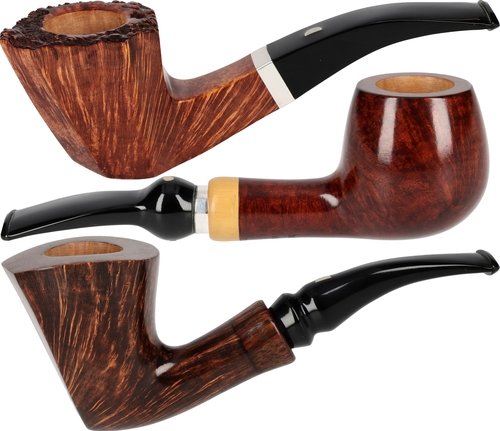
Damiano Rovera Pipes from Italian Workshop Tradition
Anyone interested in Italian pipes will inevitably come across the name Rovera. It stands for a long workshop history that began in Varese in 1911. Here in Lombardy, the family started producing Bruyère pipes. From this line emerged several names that pipe smokers still encounter today: Rovera, Rover Art, Ardor and finally Damiano Rovera.
From the Ardor Legacy to a Distinct Pipe Signature
Damiano Rovera continues this story with a distinct signature of his own. His father, Dorelio Rovera, shaped Ardor into a pipe brand known for bold shapes, expressive finishes and a clearly Italian sense of form. Wood, proportions, drilling – these terms were a natural part of the environment in which Damiano grew up. And it shows in his models; they often stay close to classic shapes, yet allow for subtle variations, stronger lines or a play with volume and grain.
Italian Pipe Shapes with Volume and Character
Typical of Damiano Rovera is this blend of Italian lightness and tangible substance. Many bowls have noticeable wall thickness, the shanks set bold accents, and the transitions between bowl, shank and stem are often deliberately sculpted. At the same time, the designs never tip into excess. A bent Dublin, an Apple or a freehand remains clearly recognisable as a pipe and suitable for everyday use. Those seeking strictly Nordic minimalism may not find what they are looking for here. But anyone drawn to organic shapes, warm stains, rusticated finishes or distinctive individual pieces will quickly appreciate the appeal.
Finishes, Grain and Surface Treatment of Rovera Pipes
The finishes also reveal much about the workshop. Smooth models highlight the grain and stand out through careful staining and a clean finish. Rusticated or sandblasted versions emphasise texture. They feel less smooth, more tactile and often somewhat more spirited.
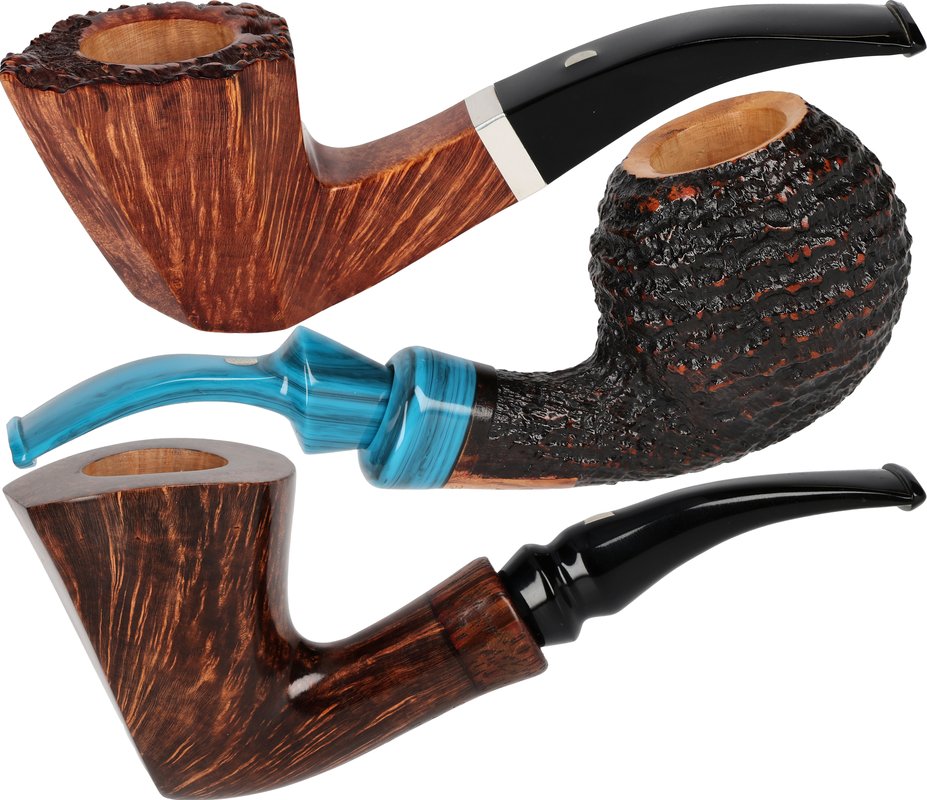
This fits well with Italian pipe making, which has never defined itself solely by measurement charts. Of course, drilling, draw and workmanship must be right. But a Rovera pipe is also about character: about a shape that sits comfortably in the hand, invites contemplation and gradually develops its own patina over time.
Small Series with Musically Inspired Model Names
Production numbers remain limited. This explains why Damiano Rovera appears more as a discovery within the range rather than a permanently available mass-produced series. Series names such as Armony, Melody, Ritmica or Sinfony already indicate that Damiano Rovera likes to think of his pipes in musical terms. This tone is no coincidence: a pipe should feel harmonious. Not every detail needs to stand out loudly, but everything should fit together. A wooden accent ring, a coloured marbled acrylic stem, a slightly conical tobacco chamber or a robust shank can noticeably change the impression of a model. The result is pipes that are neither pure classics nor pure experiments. They occupy an in-between space that many Italian manufactories find particularly compelling.
Damiano Rovera Pipes as Independent Italian Craftsmanship
In the end, Damiano Rovera does not stand for loud effects, but for a family workshop tradition that has found its own voice. The pipes combine Rovera tradition with an accessible, often slightly freer design. Their origin in Varese is evident without appearing museum-like. That is precisely their appeal: Italian craftsmanship with a feel for material, visible handwork and enough individuality not to get lost in the crowd.


