

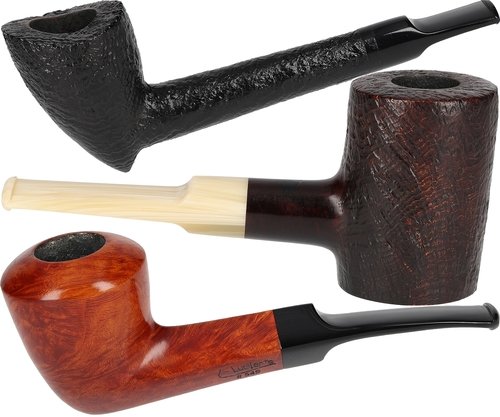
There is no devil behind Lucifer’s. In fact, these pipes come from a workshop in Berlin, where the brand is the work of Wolfram Bücker, a German pipe maker with a passion for classic shapes, distinctive details, and a sense of humor that even extends to the fallen angel. Lucifer means "light-bringer." For Wolfram, the name is less a dark message than a symbol of freedom, self-determination, and the joy of not always doing what everyone else does.
Lucifer’s Pipes by Wolfram Bücker
Born in Münster in the early 1960s, Wolfram later grew up near the Danish border, where he experienced a time when pipes were still an everyday part of life. He later moved to Berlin. His decades-long passion for pipes and pipe tobacco eventually led to the creation of Lucifer’s Pipe. This is not an anonymous factory brand or a collection conceived by a marketing department. Every model is crafted by the same man, who carefully matches the wood, shape, finish, and mouthpiece.
Handmade Pipes at Accessible Prices
Production is practical rather than pretentious. Bücker uses a lathe to carry out certain steps efficiently, saving time without turning his pipes into mass-produced factory items. Shaping, finishing, and final inspection are all done individually. That is the core of the concept: Lucifer’s offers handmade one-of-a-kind pipes that are often priced more like high-quality series pipes than exclusive high-grade pipes. Bücker himself does not consider his work part of that top-tier category. Instead, he builds pipes that are well crafted, designed to smoke well, and meant to be used regularly—not just admired on Sundays while wearing white gloves.
Briar, Bog Oak, and Olive Wood
His primary material is briar, sometimes smoothly polished, sometimes sandblasted or rusticated. Smooth finishes highlight the wood's color and grain. In addition to briar, Bücker also works with bog oak and olive wood. Bog oak offers dark tones and an almost ancient character, while olive wood appears lighter, more contrasting, and usually displays vibrant grain patterns.
9 mm Filters and Sequential Numbering
Many Lucifer’s Pipes feature a 9 mm filter bore. Remarkably, the shanks often remain quite slim despite accommodating the filter. Another appealing detail is the sequential numbering. Each number reflects the order in which the pipes were made. Pipe number 500 is indeed Wolfram's five-hundredth pipe. This turns every model into a small piece of workshop history while also making it possible to trace the evolution of shapes and craftsmanship over time. Collectors gain an interesting topic for discussion—without having to draw family trees or keep auction catalogs under their pillows.
Choosing the Right Lucifer’s Pipe
When buying a pipe, it is therefore better to look for the right proportions than for the supposedly "best" model. Weight, length, bowl height, bore, filter chamber, and mouthpiece all determine how a pipe feels in everyday use. Those who like to clench a pipe between their teeth should pay particular attention to weight and balance. Those who mainly hold it in their hand can confidently choose a larger bowl or an expansive freehand pipe. Smooth-finished models showcase the beauty of the wood, while sandblasted versions often provide a more secure grip and tend to conceal everyday signs of wear more gracefully.
German Pipe Craftsmanship for Everyday Use
Lucifer’s is one of those German pipe brands that does not treat craftsmanship as a sacred ritual. Wolfram Bücker combines experience, machine-assisted efficiency, and individual finishing to create pipes that are distinctive in appearance, practical in use, and reasonably priced. They are numbered one-of-a-kind pieces for people who want to do more than admire their pipe—they want to light it up and enjoy it.


