


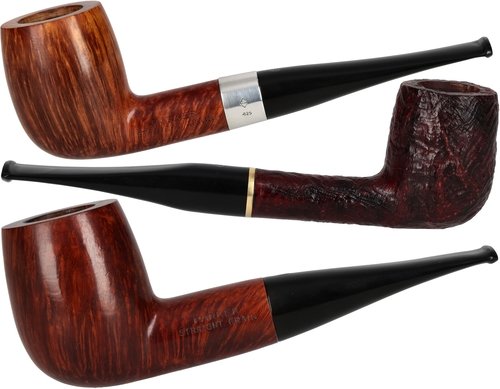
The origins of Parker Pipe Co Limited
In 1922, Alfred Dunhill founded Parker Pipe Co Limited to market pipes that Dunhill labelled as "misfits", known to collectors as "seconds". Prior to the formation of Parker, Dunhill marketed its own second-choice products by stamping a large "X" above the typical Dunhill logo. Sometimes they were also labelled with a "Damaged Price" stamp. The reduced price was marked directly on the pipe.
The early relationship between Parker and Dunhill
The exact details of the early relationship between Parker and Dunhill remain somewhat nebulous, but Parker would eventually merge with pipe manufacturer Hardcastle. In 1935 Dunhill opened a new pipe factory adjacent to Hardcastle, and in 1936 acquired 49% of the shares in Hardcastle. The remaining shares were acquired in 1946, but Parker-Hardcastle Limited was not founded until 1967. The further connections cannot be reconstructed.
Connections at factory level
The stamp records of the Dunhill factory show that Parker and Dunhill were closely linked at production level in the 1950s. However, the differences between the two brands went beyond a few minor imperfections. Most Dunhill "Seconds" were discarded after unacceptable defects became apparent during the turning of the bowl. In other words, before oil curing, drying, carving, mouthpiece machining and final finishing. Few Parkers went through the same rigorous processes as pipes intended to be Dunhill. Those that went through the entire finishing process before being considered "failures" had significant Dunhill characteristics, which is true of very few Parker pipes.
Post-war development and independence
After the Second World War and especially after the mid-1950s, the differences between Parker and Dunhill became even more pronounced. With the merger of Parker and Hardcastle Pipe Ltd. in 1967, the Parker pipe became an independent product. There is no evidence that Parker was ever marketed by Dunhill in its retail catalogue or shops.
Parker's success and return to the US market
Parker was successful in the US market from the 1930s to the 1950s, but then disappeared in the US, although it remained popular in the UK. In 1991, Parker was reintroduced to the US market and is also sold in Europe.
Parker's briar and its origins
John Loring writes in "The Dunhill Briar Pipe" that some Parker pipes from the pre-war period and the 1950s could look like Dunhill seconds. However, the briar wood used was also obtained from sources other than Dunhill. There is no way to distinguish the origin of the briar wood in Hardcastle, Parker or Parker-Hardcastle pipes. Apart from a few Parker pipes from the 1950s and some ODA moulds, one should not expect Dunhill production in these lines. Even if a Dunhill pipe could be among them, it is unlikely that this will ever be detectable.
Dating the Parker pipes
Before the Second World War, the stamp "PARKER'S" was used. However, some pipes were stamped with a different stamp as early as 1936. As with Dunhill, Parker pipes are also stamped with a date code, albeit a different one. The Parker date code always followed the stamp "MADE IN LONDON" above "ENGLAND". The first year's pipes (1923) had no date code; from 1924 the code ran consecutively from 1 to 19. There is no evidence of a date code for the war years as Parker, unlike Dunhill and Hardcastle, was not a government-authorised pipe manufacturer.
Current Parker pipes
There are currently two lines of Parker pipes which are distributed and partly manufactured by Dunhill. On the one hand, low-priced standard pipes, which are often marketed as "basket pipes" in the United Kingdom, and on the other hand, handmade freehand pipes in the medium price range with large bowls and very good sandblasting. In both cases, Parker pipes are characterised by an excellent price-performance ratio.


