Tobacco Beetles - Fighting the Cigar Enemy
One of the most feared enemies of cigars – and therefore also of all smokers and aficionados – is the Lasioderma serricorne, also known as the tobacco beetle. Its feeding can render individual cigars, entire stockpiles in the humidor, and even entire tobacco crops completely unusable. As a result, the tobacco beetle is undoubtedly one of the most economically significant pests in the entire tobacco world.
Origin and Distribution
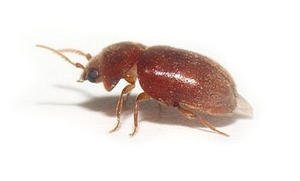
Biologically, the tobacco beetle belongs to the family of woodboring beetles. Its body is reddish-brown and has an oval shape typical for beetles, growing to about 2.5 millimeters in size. The lifespan depends on the available food supply and the ambient temperature. Generally, it ranges between 40 and 90 days – unfortunately, that's more than enough time to cause significant damage to tobacco and finished cigars.
The tobacco beetle is native to pantropical regions but only reached our Central European latitudes through global trade. It cannot survive outside human-inhabited areas due to the cold winter temperatures. The beetle prefers darker corners where tobacco and tobacco products are stored. It is, along with the drugstore beetle, the only known species that appears in stored products.
How to Recognize a Tobacco Beetle Infestation?
You can barely see the tobacco beetle with the naked eye as it is only a few millimeters in size. An infestation is usually only detected once the damage has already been done – tobacco beetles and their larvae eat small holes in the tobacco or the wrapper of cigars. If you have tobacco beetles in your home, you might also discover small round holes in food. The beetles particularly target nuts, dried fruits, and spices, in addition to tobacco.
To determine if you have a tobacco beetle infestation, several methods can be used:
- Pheromone Traps: These traps attract male tobacco beetles with female sex pheromones. The beetles are drawn to a sticky surface or liquid and drown. This method can help detect and monitor an infestation since the male beetles can no longer fertilize the females. However, in cases of a large infestation, this method alone is not sufficient.
- UV Light Trap: This trap simulates daylight and attracts beetles, which then stick to a surface. The UV light trap is mainly used to detect an infestation and does not aid in combating it.
What Happens in the Event of an Infestation?
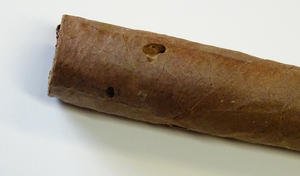
The damage starts with the packaging. The tobacco beetle not only attacks the tobacco itself but also chews through packaging. Even the larvae can penetrate packaging when searching for a suitable place to pupate. The tobacco beetle leaves behind small, round holes and tunnels that are relatively easy to spot.
The droppings left behind by the feeding, as well as the remains of the tobacco beetles themselves, contaminate the affected tobacco to such an extent that it becomes unsuitable for smoking. If the cigar’s wrapper is eaten through, the draw of the cigar is also massively affected. Although nicotine was once used for pest control, it unfortunately offers no protection against tobacco beetle infestations.
How to Prevent a Beetle Infestation?
Manufacturers, importers, and retailers have a variety of measures to prevent or combat tobacco beetle infestations. In the past, the spread was prevented by fumigation, but today, infested tobacco is treated with nitrogen and hydrogen or subjected to high-pressure carbon dioxide. Pheromone and UV light traps are used to detect infestations. Since the tobacco beetle requires relatively high temperatures, storing cigars at consistently low temperatures can help prevent an infestation. To take advantage of this temperature sensitivity, cigars are frozen by importers when entering the market.
Most of the tobacco beetle's cocoons are found on the inside of packaging. Be sure to check any purchased goods for infestations. Other preventive measures include:
- Keep storage rooms and cabinets clean.
- Store tobacco, cigars, and food in cool places.
- Regularly check for tobacco beetle infestations using pheromone or UV light traps.
What to Do If My Cigars Are Infested?
If you find that cigars in your home humidor are infested with tobacco beetles, the affected cigars should be sorted out. It is recommended to inspect each cigar carefully, as the holes can be relatively easy to identify. Be thorough, as the holes can also be located under the band.
To prevent further infestations, there are several measures that can easily be carried out at home. Place all cigars from the humidor in resealable freezer bags and store them in the freezer or the freezer compartment of your fridge for several days. After about a week, take the cigars out of the freezer and let them thaw in the bags to retain their moisture and avoid the wrappers tearing during thawing. At the same time, the humidor should be cooled for a few days. It should first be thoroughly cleaned with distilled water and cleared of any tobacco remnants. After this cold treatment, your cigar stock will no longer have any tobacco beetles.
If you find a tobacco beetle infestation in your home, using insecticides is rarely necessary. Instead, follow these steps:
Tobacco Beetle Control Checklist
- Inspect all cigars in the humidor and remove affected ones. They can be easily identified by the holes. We recommend carefully checking each cigar, as holes may also be located under the band.
-
Place all cigars without holes in resealable freezer bags and store them in the freezer or the freezer compartment of your fridge for about a week.
-
After a week, allow the cigars to thaw in the bags. This way, they will retain their moisture, and the wrappers won’t tear.
-
Thoroughly clean the humidor with distilled water and cool it as well.
- Also check all food in the entire storage area or kitchen. Dispose of any infested food immediately and thoroughly clean the shelves and cabinets.