


Casa 1910 Cuchillo Parado
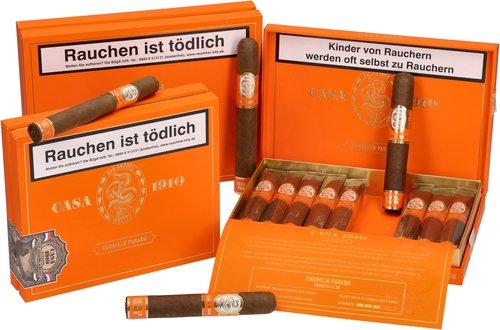
The Casa 1910 Cuchillo Parado arrived at our shop in 2026 together with the Casa 1910 Tierra Blanca. In contrast to the considerably darker Tierra Blanca, it reveals a different side of Mexican cigars. The wrapper is grown from Mexican Sumatra seed and aged for three years, while the San Andrés binder is aged for five years. The filler also consists of Mexican tobacco from San Andrés. After rolling, the finished cigars are given another six to eight months of rest. This makes the series ideal for aficionados who want to explore Mexican tobacco without starting with an especially full-bodied Maduro profile.
Casa 1910 Cuchillo Parado: the Beginning of a Mexican Cigar Brand
The Cuchillo Parado was Casa 1910's first cigar and was introduced back in 2021. Its name is a direct reference to the Mexican Revolution. Cuchillo Parado is a town in the state of Chihuahua where Toribio Ortega Ramírez and his men took action against the regime of Porfirio Díaz in November 1910. The name Casa 1910 also refers to this period. The project was founded by Juan Manuel “Manolo” Santiago Casillas, Jamie Bär and Serge Bollag. Santiago previously spent many years distributing Cuban cigars in Mexico and also developed the Cuchillo Parado blend. The other two founders have backgrounds in finance and lived in Mexico for some time, which is also where the idea originated. The longfiller cigars are rolled in Mexico, although the exact tabacalera has not been disclosed. The focus is on tobaccos from the traditional growing region of San Andrés.
Corona, Robusto and Toro of the Casa 1910 Cuchillo Parado
The series was originally released exclusively as the Cuchillo Parado Robusto in a 5 x 50 format. As part of the range's revamp, two additional vitolas were introduced in 2026. The slender Cuchillo Parado Corona at 5½ x 42 puts greater emphasis on the ratio of wrapper to filler and delivers a more concentrated smoking experience. At 5 x 50, the Robusto remains the compact classic of the series. Finally, the Cuchillo Parado Toro at 6 x 52 provides greater length and volume for the San Andrés filler. This gives aficionados a choice of three familiar formats, each offering a different interpretation of the same all-Mexican blend. An interesting series for cigar enthusiasts looking to discover just how versatile Mexican tobacco can be beyond the well-known dark San Andrés wrapper. After a few detours, Casa 1910 is now imported and distributed by VCF Cigars (Vandermarliere Cigar Family). In 2016, the Vandermarliere family acquired cigar manufacturer Oliva Cigars, meaning it now owns the company, including its plantations and factories, and also distributes other renowned manufacturers such as AJ Fernandez and Plasencia.
Other series by Casa 1910





Manufacturing types
| Logo | Abkürzung | Beschreibung |
|---|---|---|
 |
MM | Machine Made (vollkommen von Maschinen hergestellte Zigarren, daher das Fabriksymbol) |
 |
HAM | Hecho a Mano, d.h. dies ist eine Mischform – die Einlage mit der Maschine, das Deckblatt von Hand überrollt |
 |
TAF | Totalmente a Mano, d.h. komplett von Hand hergestellt ABER mit gerissener Einlage (dies ist die offizielle Bezeichnung der Kubaner dafür) |
 |
TAM | Totalmente a Mano, komplett von Hand hergestellt mit ganzen Blättern |


