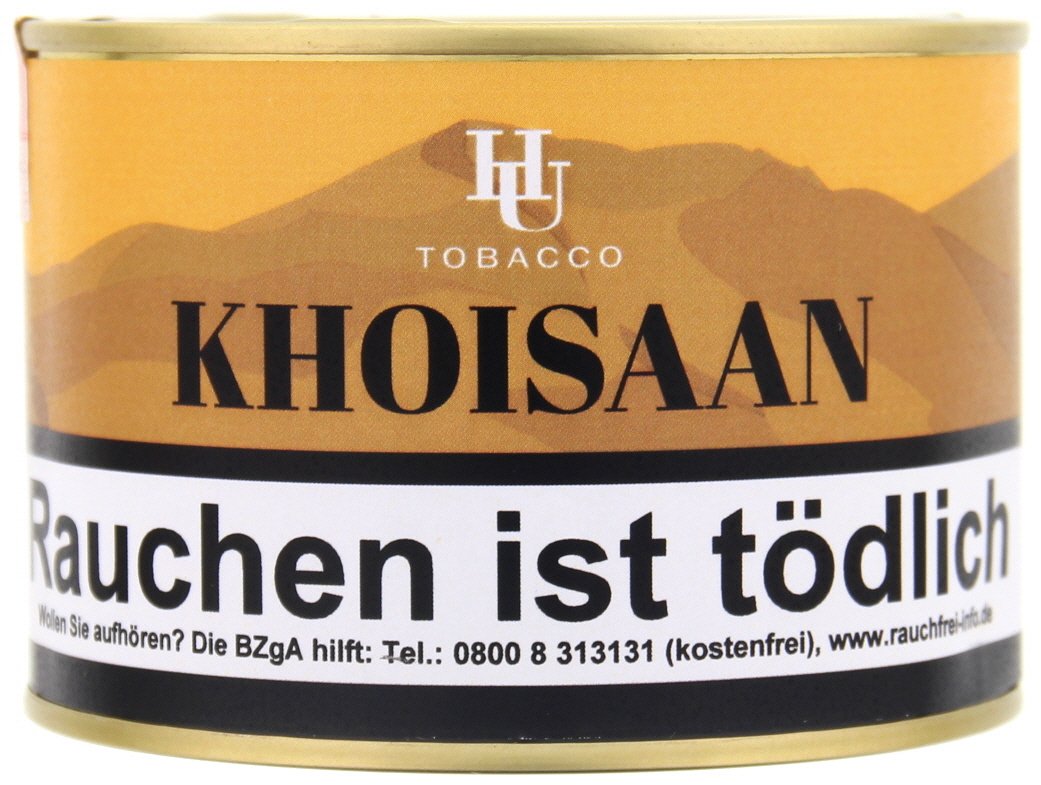
HU Tobacco African Line Khoisaan 100g Dose
Place order
Khoisaan 100g Dose
Price
Amount
Unit
Wird oft zusammen bestellt
Khoisaan ist ein schwarzer, vollwürziger Latakia-Blend. Rauchig zypriotischer Latakia, abgemischt mit reichlich Louisiana Perique und kräftigem Firecured Virginia aus Tansania. Das Ergebnis ist ein vollwürziger gehaltvoller Blend mit hintergründigen Holz- und Fruchtnoten. Der Khoisaan ist eine komplexe Mischung für den erfahrenen Raucher.
Item number (SKU)
90022315
In the assortment since
27.03.2018
Brand
Cut
Aroma
4
Room fragrance
4
Flavouring
type
Strength
Flavor Profile
Raw tobacco
room smell
Average Aroma Rating (1)
Importer
HU Tobacco, Südenstr. 20, 86756 Reimlingen, hu-tobacco@t-online.de, https://hu-tobacco.de
HU Tobacco, Südenstr. 20, 86756 Reimlingen, hu-tobacco@t-online.de, https://hu-tobacco.de
Customers who looked at this product bought the following thereafter


Ratings
Price/Value
4
1 Bewertungen
Quality
8
1 Bewertungen
Strength
7
1 Bewertungen
My tobacco stash

Sven 1. Introduction: The HU Khoisaan, belonging to the African Line conceived by the discerning Mr Hans Wiedemann of HU Tobacco and produced by Messrs Kopp of Germany, presents itself as a robust and darkly aromatic composition, poised between the nobility of English tradition and a distinctly German interpretation of the African spirit. It unites Cypriot Latakia, Louisiana Périque, and fire-cured Virginia from Tansania - a combination at once rare and geographically poetic. Thus, it gestures towards the venerable lineage of the “Balkan” or “English” mixtures, yet renounces the inclusion of Oriental leaf in favour of an earthier, smokier, and duskier foundation. This deliberate deviation bestows upon it a singular character that endures from the first ember to the final wisp. 2. Appearance & Cut: The tobacco reveals itself in a loose, ribbon-like cut, its broad, gently twisted strands glistening with oils of a hue approaching tar. Amongst the sable fibres of Latakia flicker the warm browns of the fire-cured Virginia. The impression is somewhat rustic and unadorned - less the immaculate precision of Dunhill’s classic ribbon cut than a craftsman’s hand-finished work. The sample’s moisture is commendably balanced, requiring little attention before packing. 3. Cold Aroma: At first unsealing, the HU Khoisaan breathes forth a dense, dark perfume of smoke, resin, and tanned hide, underlaid by a fermentative sweetness reminiscent of dried plums and ancient wood. The Périque contributes a piquant fruit acidity which, entwined with the smoky Latakia, evokes the atmosphere of an old mercantile office - tarred ropes, polished mahogany, and the dusty dignity of aged ledgers. It is no delicate bouquet, but an honest, earthen aroma promising depth rather than mere brilliance. 4. The Smoke: Opening: The introduction is imposing, almost monumental. The Latakia announces itself with billows of grave, aromatic smoke, accompanied by a modest yet spirited sharpness from the Périque. The Virginias provide structure and warmth, though little in the way of overt sweetness. Mid-Bowl: Balance then emerges as the peppery fruit of the Périque tempers Latakia’s resinous dominance. The fire-cured Virginias contribute a dense, almost bacon-like undertone, akin to seasoned oak smouldering on the hearth. The aroma remains dark, never dull; patient puffing reveals shades of black pepper, antique leather, and the faintest whisper of cocoa bean. Finale: As the bowl wanes, the blend grows drier, more austere. Sweetness retreats, gravity ascends. The closing evokes the dying embers of a camp-fire - quiet glow, little ash, but abiding warmth upon the palate. Impetuous puffing may provoke heat; leisurely contemplation keeps the smoke cool and well-ordered. 5. Combustion & Technique: In its mechanical virtues, HU Khoisaan behaves with reliability. The burn is steady, the ember resolute, the ash of a refined, pale grey. It rewards a light hand upon packing - over-compression may induce resistance. Ordinarily one relight suffices, and the mixture performs admirably in medium-sized briars. 6. Room Note: The ambient aroma is unmistakable - voluminous, tarry, and reminiscent of hearth-smoke, canvas, and pitch. It is no fragrance for parlour propriety, yet to the seasoned connoisseur it carries the dignified gravity of the true English genre. To the uninitiated, it may prove formidable. 7. Comparison & Context: For decades the Dunhill house has to me embodied the canon of English refinement - balanced, poised, and distinct in character. Against such paragons, Khoisaan asserts itself as a vigorous but slightly less finely sculpted cousin: - Dunhill’s London Mixture represents classical equilibrium: bright Virginias, noble Orientals, and a mild Latakia accent weave a luminous and graceful smoke. Beside this transparency, HU Khoisaan appears darker, denser, and more earthen, its aroma less aerial, more corporeal. - Dunhill’s My Mixture 965 adds weight through an opulent measure of Latakia, cushioned in the Scottish way by a gentle Brown Cavendish sweetness. HU Khoisaan mirrors Dunhill’s My Mixture 965 in depth, yet where Dunhill glides with rounded creaminess, HU’s creation is sinewy and robust - the contrast between salon velvet and the hunter’s weathered suede. - Dunhill’s Nightcap stands as its closest spiritual kinsman. Both share a sombre gravitas and the pointed presence of Périque. Yet where Dunhill’s Nightcap remains aristocratic and composed, HU Khoisaan ventures nearer the primeval frontier. Its smoke is harsher, its footing earthier, its echo touched by a wilder, almost colonial vigour. Dunhill’s Nightcap reclines within the club chair after midnight; HU Khoisaan crackles beneath the southern stars. - Dunhill’s Durbar, conversely, embodies the bright, oriental-spiced facet of Dunhill’s art—complex, elegant, airy. Its bouquet unfolds like a carpet of cedar, citrus, and Eastern spice. In contrast, HU Khoisaan is its dusky counterpart: devoid of Orientals, stripped of ethereal levity, yet endowed with smoky power and grave, terrestrial warmth. Taken in the whole, HU Khoisaan does not imitate Dunhill but deliberately diverges from it. It is an English mixture translated through a German sensibility, coloured by an African accent - less polished and aristocratic, more immediate, virile, and elemental. Blends akin in spirit might include Huber’s English Balkan or Magne Falkum’s Free Minds No. 1. 8. Suitability & Recommendation: Recommended for: devotees of strong Latakia mixtures - those who favour Dunhill‘s Nightcap, Ashton‘s Artisan’s Blend, or the heavy Gawiths such as Balkan Flake and Commonwealth Mixture. Not recommended for: novices, admirers of light oriental blends (Durbar, London Mixture), or those devoted to the saccharine refinements of US-American or Danish aromatics. 9. Conclusion: The HU Khoisaan is a tobacco for the contemplative smoker who seeks the dark, the smoky, and the unadorned. It marries craftsmanship with vigour, eschewing facile sweetness for authentic depth. Those yearning for the chiseled symmetry of Dunhill’s golden age may find it rugged; yet to those who honour in tobacco the archaic flame and the earth’s own gravity, it will prove a worthy companion. The HU Khoisaan is no gentleman in a velvet smoking-jacket by the fireplace - it is the hunter, still in his leather waistcoat, resting after the chase. And therein lies its abiding charm.
18.02.2026
Sven 1. Introduction: The HU Khoisaan, belonging to the African Line conceived by the discerning Mr Hans Wiedemann of HU Tobacco and produced by Messrs Kopp of Germany, presents itself as a robust and darkly aromatic composition, poised between the nobility of English tradition and a distinctly German interpretation of the African spirit. It unites Cypriot Latakia, Louisiana Périque, and fire-cured Virginia from Tansania - a combination at once rare and geographically poetic. Thus, it gestures towards the venerable lineage of the “Balkan” or “English” mixtures, yet renounces the inclusion of Oriental leaf in favour of an earthier, smokier, and duskier foundation. This deliberate deviation bestows upon it a singular character that endures from the first ember to the final wisp. 2. Appearance & Cut: The tobacco reveals itself in a loose, ribbon-like cut, its broad, gently twisted strands glistening with oils of a hue approaching tar. Amongst the sable fibres of Latakia flicker the warm browns of the fire-cured Virginia. The impression is somewhat rustic and unadorned - less the immaculate precision of Dunhill’s classic ribbon cut than a craftsman’s hand-finished work. The sample’s moisture is commendably balanced, requiring little attention before packing. 3. Cold Aroma: At first unsealing, the HU Khoisaan breathes forth a dense, dark perfume of smoke, resin, and tanned hide, underlaid by a fermentative sweetness reminiscent of dried plums and ancient wood. The Périque contributes a piquant fruit acidity which, entwined with the smoky Latakia, evokes the atmosphere of an old mercantile office - tarred ropes, polished mahogany, and the dusty dignity of aged ledgers. It is no delicate bouquet, but an honest, earthen aroma promising depth rather than mere brilliance. 4. The Smoke: Opening: The introduction is imposing, almost monumental. The Latakia announces itself with billows of grave, aromatic smoke, accompanied by a modest yet spirited sharpness from the Périque. The Virginias provide structure and warmth, though little in the way of overt sweetness. Mid-Bowl: Balance then emerges as the peppery fruit of the Périque tempers Latakia’s resinous dominance. The fire-cured Virginias contribute a dense, almost bacon-like undertone, akin to seasoned oak smouldering on the hearth. The aroma remains dark, never dull; patient puffing reveals shades of black pepper, antique leather, and the faintest whisper of cocoa bean. Finale: As the bowl wanes, the blend grows drier, more austere. Sweetness retreats, gravity ascends. The closing evokes the dying embers of a camp-fire - quiet glow, little ash, but abiding warmth upon the palate. Impetuous puffing may provoke heat; leisurely contemplation keeps the smoke cool and well-ordered. 5. Combustion & Technique: In its mechanical virtues, HU Khoisaan behaves with reliability. The burn is steady, the ember resolute, the ash of a refined, pale grey. It rewards a light hand upon packing - over-compression may induce resistance. Ordinarily one relight suffices, and the mixture performs admirably in medium-sized briars. 6. Room Note: The ambient aroma is unmistakable - voluminous, tarry, and reminiscent of hearth-smoke, canvas, and pitch. It is no fragrance for parlour propriety, yet to the seasoned connoisseur it carries the dignified gravity of the true English genre. To the uninitiated, it may prove formidable. 7. Comparison & Context: For decades the Dunhill house has to me embodied the canon of English refinement - balanced, poised, and distinct in character. Against such paragons, Khoisaan asserts itself as a vigorous but slightly less finely sculpted cousin: - Dunhill’s London Mixture represents classical equilibrium: bright Virginias, noble Orientals, and a mild Latakia accent weave a luminous and graceful smoke. Beside this transparency, HU Khoisaan appears darker, denser, and more earthen, its aroma less aerial, more corporeal. - Dunhill’s My Mixture 965 adds weight through an opulent measure of Latakia, cushioned in the Scottish way by a gentle Brown Cavendish sweetness. HU Khoisaan mirrors Dunhill’s My Mixture 965 in depth, yet where Dunhill glides with rounded creaminess, HU’s creation is sinewy and robust - the contrast between salon velvet and the hunter’s weathered suede. - Dunhill’s Nightcap stands as its closest spiritual kinsman. Both share a sombre gravitas and the pointed presence of Périque. Yet where Dunhill’s Nightcap remains aristocratic and composed, HU Khoisaan ventures nearer the primeval frontier. Its smoke is harsher, its footing earthier, its echo touched by a wilder, almost colonial vigour. Dunhill’s Nightcap reclines within the club chair after midnight; HU Khoisaan crackles beneath the southern stars. - Dunhill’s Durbar, conversely, embodies the bright, oriental-spiced facet of Dunhill’s art—complex, elegant, airy. Its bouquet unfolds like a carpet of cedar, citrus, and Eastern spice. In contrast, HU Khoisaan is its dusky counterpart: devoid of Orientals, stripped of ethereal levity, yet endowed with smoky power and grave, terrestrial warmth. Taken in the whole, HU Khoisaan does not imitate Dunhill but deliberately diverges from it. It is an English mixture translated through a German sensibility, coloured by an African accent - less polished and aristocratic, more immediate, virile, and elemental. Blends akin in spirit might include Huber’s English Balkan or Magne Falkum’s Free Minds No. 1. 8. Suitability & Recommendation: Recommended for: devotees of strong Latakia mixtures - those who favour Dunhill‘s Nightcap, Ashton‘s Artisan’s Blend, or the heavy Gawiths such as Balkan Flake and Commonwealth Mixture. Not recommended for: novices, admirers of light oriental blends (Durbar, London Mixture), or those devoted to the saccharine refinements of US-American or Danish aromatics. 9. Conclusion: The HU Khoisaan is a tobacco for the contemplative smoker who seeks the dark, the smoky, and the unadorned. It marries craftsmanship with vigour, eschewing facile sweetness for authentic depth. Those yearning for the chiseled symmetry of Dunhill’s golden age may find it rugged; yet to those who honour in tobacco the archaic flame and the earth’s own gravity, it will prove a worthy companion. The HU Khoisaan is no gentleman in a velvet smoking-jacket by the fireplace - it is the hunter, still in his leather waistcoat, resting after the chase. And therein lies its abiding charm.